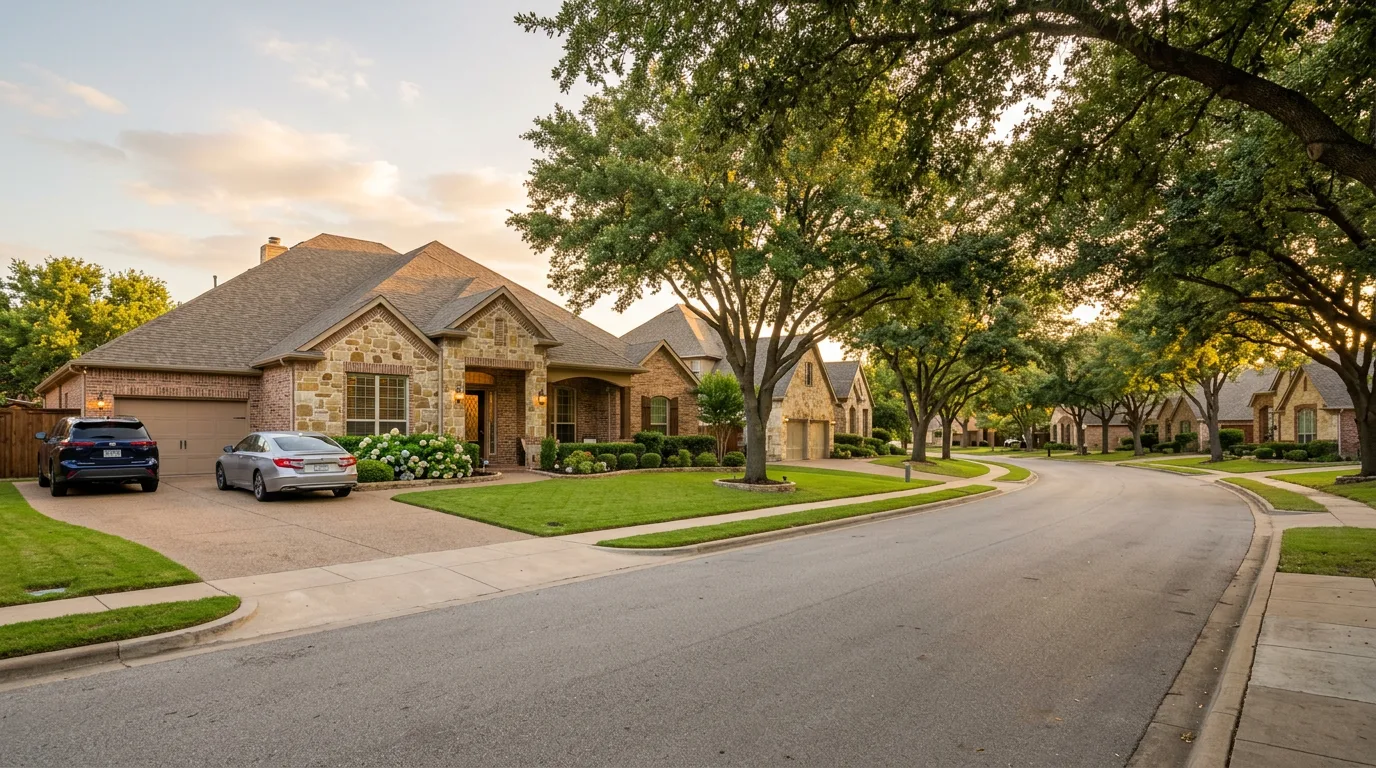
Probate Real Estate in Collin County, Texas
Collin County — encompassing Plano, Frisco, McKinney, Allen, Wylie, Celina, and dozens of fast-growing communities north of Dallas — has transformed from a rural farming county into one of the wealthiest, fastest-growing counties in the United States over the past three decades. With a population approaching 1.2 million, one of the highest median household incomes in Texas, and a real estate market that has appreciated aggressively since the 2010s, Collin County probate estates often carry substantial equity that heirs and executors need to protect.
Collin County Probate Court
Collin County probate matters are handled by the County Court at Law, located at the:
Collin County Courthouse 2100 Bloomdale Road, McKinney, TX 75071 Phone: (972) 548-4320
McKinney is the county seat, which means all probate filings, hearings, and court records are centralized there — a practical consideration for executors managing estates in Plano or Frisco, roughly 20–30 minutes south. The Collin County Probate Court manages a shared docket across the county courts at law; most hearings are scheduled 3–5 weeks after filing.
Court Hours: Monday–Friday, 8:00 AM – 5:00 PM Filing fees: Approximately $300–$450 depending on estate type and documentation
Collin County Probate Timeline
Most Collin County independent administrations follow this timeline:
| Phase | Typical Duration |
|---|---|
| File application and schedule hearing | 1–2 weeks |
| Probate hearing and appointment | 2–4 weeks after filing |
| Receive Letters Testamentary | Same day as hearing |
| Estate inventory due | Within 90 days of appointment |
| List and market the property | Anytime after appointment |
| Accepted offer to closing | 30–60 days (title work on executor’s deed) |
| Total (list to close) | 4–7 months from date of death |
Independent administration — the streamlined form that allows executors to act without court approval on most decisions, including property sales — is the default in Texas when the will authorizes it or all heirs consent. The vast majority of Collin County estates qualify and proceed under independent administration.
Collin County Real Estate Market Overview
Collin County’s real estate market spans several distinct submarkets, each with different buyer profiles and pricing dynamics relevant to probate sellers:
| Submarket | Key Cities | Typical Price Range | Buyer Profile |
|---|---|---|---|
| Established Plano | West Plano, Legacy area | $400K–$800K | Corporate relocation, move-up families |
| New Frisco | Craig Ranch, Hollyhock, Phillips Creek | $550K–$1.1M | Families, DFW corporate executives |
| McKinney Historic | Downtown McKinney, Eldorado | $350K–$600K | Character buyers, investors |
| McKinney Master-Planned | Trinity Falls, Painted Tree | $380K–$650K | Young families, first-time move-up |
| Allen / Wylie | Established neighborhoods | $300K–$500K | Budget-conscious DFW families |
| Far North (Celina, Anna) | New development | $350K–$550K | Value seekers, commuters |
Key insight for probate sellers: Collin County’s market is dominated by retail buyers — families and professionals, not investors. Properly presented probate properties with updated photos and reasonable pricing routinely attract multiple offers. The “distressed probate discount” that buyers try to extract in other markets is largely avoidable in Collin County with proper preparation.
Property Tax Considerations
Collin County property taxes present specific issues for probate estates:
Homestead exemption termination: The deceased owner’s homestead exemption terminates on January 1 of the year following death. If the estate holds the property into the next tax year, it will be taxed at the full assessed value without the homestead reduction — often adding $1,500–$4,000 to the annual tax bill depending on property value.
Over-65 and disabled exemptions: These also terminate at death. Check with the Collin Central Appraisal District (CCAD) at 250 Eldorado Pkwy, McKinney, TX 75069, (469) 742-9200 to confirm current exemption status and assess the tax impact on carrying costs.
Tax rates: Collin County’s effective property tax rate averages 1.8–2.2% of assessed value, depending on city and school district. On a $500,000 property, that’s $9,000–$11,000 per year — roughly $750–$900 per month in carrying costs while the estate holds the property.
Delinquent taxes: Any outstanding property tax balance must be resolved at closing. Delinquent taxes accrue interest and penalties at 1% per month plus a potential 20% attorney fee after July 1. Pull tax records early from the county’s tax assessor-collector office.
School Districts and Property Value
School district assignment is one of the most significant pricing factors in Collin County — and one of the most frequently misunderstood in probate contexts:
- Frisco ISD — Commands a measurable premium. Properties in desirable FISD zones consistently outperform adjacent districts at comparable price points. Verify elementary school assignment specifically, as it varies significantly within FISD boundaries.
- Plano ISD — Well-regarded and stable. Strong corporate relocation buyer pool.
- McKinney ISD — Good district; properties near the Frisco border may actually be in Frisco ISD — verify before listing.
- Allen ISD — Highly regarded; Allen ISD properties are increasingly competitive with Plano.
Confirming the correct school district assignment before listing is essential. In north Plano (75024/75025 zip codes), the line between Plano ISD and Frisco ISD runs through residential neighborhoods — a few streets can mean a $30,000–$50,000 difference in market value.
HOA Considerations in Probate
Collin County’s master-planned communities almost universally have HOAs, and HOA matters require immediate attention in a probate estate:
- Dues continue to accrue regardless of probate status. Notify the HOA of the owner’s death immediately to establish executor authority.
- Violation notices issued to a deceased owner can escalate into fines and liens if not addressed. The executor is responsible for maintaining compliance.
- Transfer fees are typically due at closing — budget $200–$500 per HOA (some properties belong to multiple HOAs — a community HOA and a sub-association).
- In master-planned communities like Stonebridge Ranch in McKinney or Starwood in Frisco, HOA restrictions can affect sale timelines (required inspections, sign restrictions, etc.). Consult with your agent before listing.
Community Property and Collin County Estates
Texas is a community property state. For married Collin County property owners:
- Property acquired during the marriage is presumed community property, owned 50/50 by both spouses.
- At death, only the decedent’s 50% interest passes through their estate. The surviving spouse retains their 50% automatically — no probate required for that share.
- Separate property (owned before marriage, or acquired by gift or inheritance) passes entirely through the estate.
- Many Collin County properties purchased by couples in the 1990s–2000s have complex ownership histories involving refinancing, title changes, and equity distributions — always review the deed carefully before assuming ownership structure.
Out-of-State Heirs and Remote Executors
Collin County sees significant out-of-state heir situations — adult children who relocated to other states while their parents remained in the DFW suburbs. Texas probate law accommodates remote administration effectively:
- Powers of attorney allow an in-state representative to act on the executor’s behalf for day-to-day estate matters.
- Remote online notarization (RON) is fully legal in Texas — executor’s deeds and other estate documents can be signed and notarized digitally, eliminating the need to fly back for closing.
- Electronic filing is available for most Collin County court filings through the Tyler Technologies e-filing portal.
- The executor must appear (or be represented) at the probate hearing, but the hearing itself is brief — typically 10–15 minutes. Many out-of-state executors schedule a single trip to cover the hearing, property walkthrough, and estate cleanout.
Why Use a Probate Real Estate Specialist in Collin County
Collin County’s market moves quickly and rewards preparation. A probate real estate specialist brings:
- CMA for estate inventory: Required within 90 days of appointment. A specialist can provide this immediately after appointment, helping meet the court deadline and establish accurate estate values.
- Buyer network: In a competitive market, access to pre-qualified buyers and investor networks can shorten days-on-market and improve net sale price.
- Contractor relationships: For estates that need cleanout, repairs, or staging before listing, a specialist can coordinate trusted vendors at estate-appropriate rates.
- Court coordination: Understanding how Collin County title companies handle executor’s deeds prevents closing delays common with agents unfamiliar with probate transactions.
Initial consultations are always free, and our fee comes only at closing — no upfront cost to the estate.
Frequently Asked Questions — Collin County Probate Real Estate
Can I sell a Plano or Frisco house while probate is still open? Yes. Under Texas independent administration, you can list and sell the property at any point after receiving Letters Testamentary. You do not need to wait for the estate to close. The closing will use an executor’s deed instead of a standard warranty deed — most Collin County title companies handle this routinely.
How long does probate take in Collin County? Most independent administrations take 4–6 months from filing to when the estate is in a position to close a property sale. The property can be listed immediately after appointment, but closing typically takes 30–60 additional days for title work. Executors who file promptly and prepare the property quickly can often close within 5–7 months of the date of death.
Does Collin County require court approval to sell probate property? Under independent administration (which most Collin County estates qualify for), court approval is not required to sell real property. The executor signs the contract and deed using their Letters Testamentary as authority. Dependent administration — which requires court approval for each major transaction — is rare and typically only occurs when the will requires it or heirs cannot agree on administration.
What if multiple heirs disagree about selling a Collin County property? If heirs cannot agree, the executor still has legal authority under independent administration to list and sell the property to satisfy estate debts and distribute assets. In cases without a will, disagreeing heirs may need to resolve the dispute through the probate court or a partition action. A probate real estate specialist can often help facilitate heir communication before disputes escalate to litigation.
Are Collin County probate properties sold as-is? Not necessarily. Many Collin County properties benefit from cosmetic updates before listing — the market rewards move-in-ready homes. However, the decision depends on the specific property, current inventory, and the cost-benefit analysis of repairs. A specialist can advise on which improvements will improve net sale price and which won’t.
Heir or executor of a Collin County property? Get a free consultation with a probate real estate specialist serving Plano, Frisco, McKinney, Allen, and all of Collin County.
Free consultation
Get a Free Collin County Probate Consultation
Tell us about your Collin County probate property. We'll respond within one business day — no obligation.