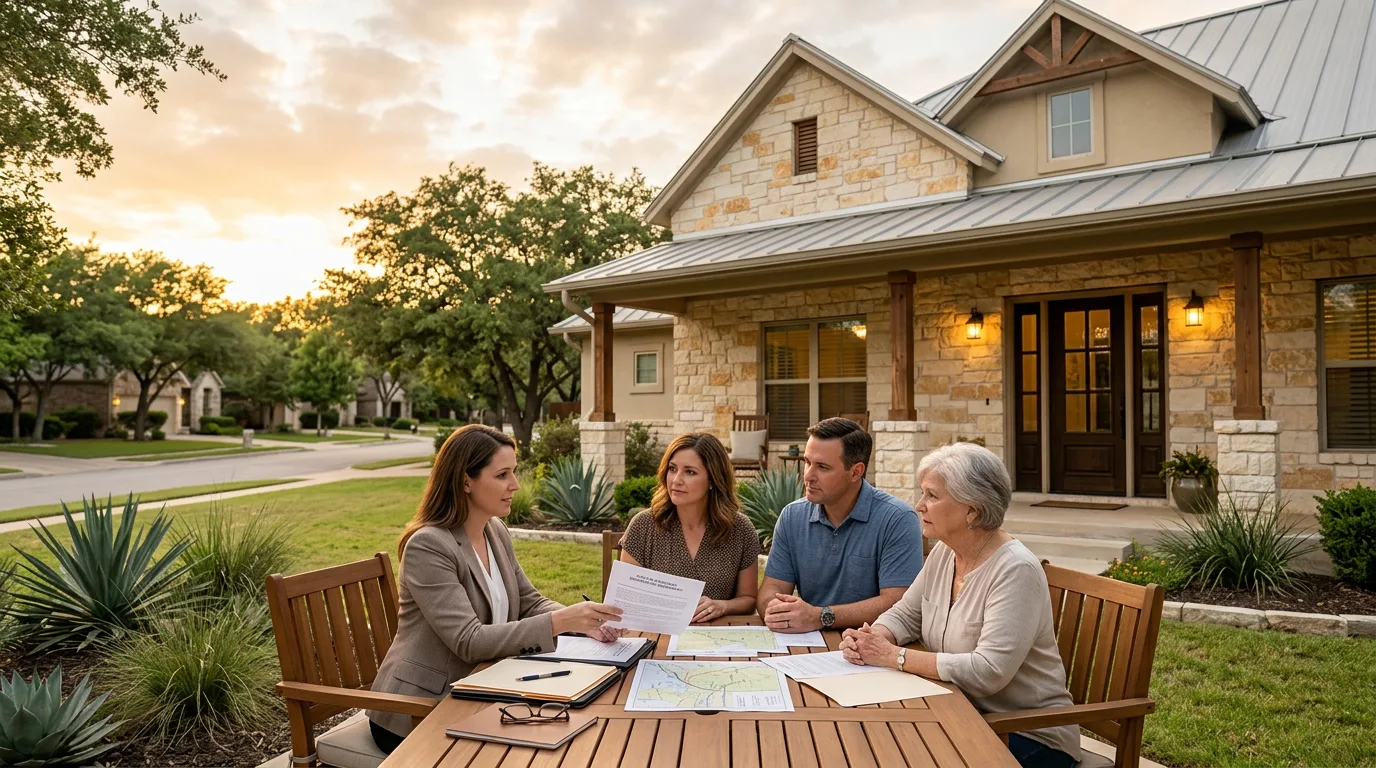
Inheriting a property with siblings or other family members sounds straightforward on paper. In practice, it’s one of the most common sources of probate delay, financial loss, and family conflict in Texas estate administration. When heirs disagree — about whether to sell, what to list it for, how much to invest in repairs, or who gets what — the consequences can be expensive for everyone involved.
This guide explains how multi-heir Texas estates work legally, what happens when heirs disagree, and how families can navigate the process without destroying relationships or estate value.
How Multiple Heirs Inherit Property in Texas
When a Texas property owner dies, their interest in real property passes to heirs in one of two ways:
Through a will. If the decedent left a valid will, the will determines who inherits what share of the property. A will might leave the property equally to three children, or it might leave a different percentage to different heirs, or it might leave the property to a single heir outright.
Through intestate succession. If the decedent died without a will, Texas intestate succession laws determine who inherits. For a married decedent, the rules depend on whether the property was community property or separate property and whether the decedent had children from outside the marriage. For an unmarried decedent, the property typically passes equally to children, or up the family tree if there are none.
The critical point: multiple heirs each hold an undivided interest in the property. No single heir owns a specific room or portion of the home — each heir owns a fractional share of the whole. This creates the potential for disagreement because any significant decision about the property — selling it, renting it, making improvements — effectively requires the cooperation of all owners.
When Heirs Agree: The Straightforward Path
If all heirs want to sell and agree on the general approach, a multi-heir Texas estate sale is not fundamentally more complicated than a single-heir sale. The executor (or administrator, if there is no will) has authority under independent administration to sell the property and distribute proceeds proportionally to each heir’s share.
The main practical considerations when heirs agree:
Agree on priorities upfront. Before listing, heirs should discuss and document: target sale price range, acceptable offer terms, how much (if anything) to spend on repairs or staging, and the distribution timeline. Getting these decisions made in writing — even informally — prevents disputes later when a real offer is on the table.
Coordinate document signing. Multiple heirs may need to sign documents throughout the transaction. Out-of-state heirs should arrange powers of attorney early so delays at closing are avoided. Texas allows Remote Online Notarization (RON), so out-of-state signers don’t need to physically travel.
Address the homestead question. If the decedent was married and the surviving spouse still lives in the property, Texas homestead rights give the surviving spouse a right of occupancy that can complicate or delay a sale. This requires careful handling by the estate attorney.
When Heirs Disagree: Your Legal Options
The more common — and more difficult — scenario is when heirs cannot agree. One wants to sell immediately. Another wants to keep the property. A third wants to rent it out. A fourth is absent and won’t respond to communications.
Here’s what the law allows.
Option 1: Negotiated Buyout
The most common resolution when one heir wants to keep the property and others want to sell. The heir who wants to retain the property buys out the others’ shares at fair market value.
How it works:
- Commission an independent appraisal or CMA to establish a fair market value
- The buying heir arranges financing (cash, refinance of existing mortgage, home equity loan, or estate financing)
- The selling heirs receive their proportional share of the agreed value
- Title transfers to the buying heir through a deed signed by all parties
Why it’s often the best option: A buyout avoids the cost and delay of court proceedings, preserves family relationships better than litigation, and keeps the property in the family if that’s what one heir values. The key is agreeing on a fair value — using an independent appraisal rather than one heir’s opinion prevents the most common source of dispute.
Typical timeline: 30–90 days if financing is arranged promptly.
Option 2: Rental Arrangement with Future Sale
Sometimes heirs agree to rent the property in the short term — generating income for the estate while disagreements are resolved or while one heir makes arrangements to buy out the others.
This approach works best when:
- The property is in rentable condition without major repairs
- All heirs agree to the rental arrangement and profit-sharing
- There is a defined end date (e.g., “we’ll rent for 12 months, then reassess”)
Without a clear agreement and timeline, temporary rental arrangements often become permanent, and the property falls into deferred maintenance while heirs continue to disagree. If pursuing this route, document the arrangement in writing with the help of an attorney.
Option 3: Mediation
Before escalating to litigation, mediation offers a structured process for heirs to negotiate a resolution with the help of a neutral third party. A probate or real estate mediator facilitates conversations that direct negotiation cannot.
Mediation is particularly effective when:
- Heirs have emotional attachments to the property that make direct negotiation difficult
- There are family dynamics (long-standing grievances, unequal treatment by the decedent) complicating the financial discussion
- The core dispute is about process or perceived fairness, not fundamentally irreconcilable goals
Cost: Texas mediators typically charge $150–$400 per hour; most multi-heir property disputes resolve in a half-day to full-day session.
Binding vs. non-binding: Mediated agreements can be made binding when signed by all parties, giving them the force of a contract. This is highly recommended.
Option 4: Partition Action
When all other options fail, any co-owner of Texas real property has the legal right to file a partition action in district court. A partition action forces a resolution when heirs cannot agree.
Partition in kind (physical division of the property): Rarely practical for residential real estate. Courts can theoretically divide a large rural tract, but a single-family home cannot be physically divided into separate ownership interests.
Partition by sale (forced sale): The court orders the property sold — typically at public auction or through a court-supervised listing — and the proceeds divided among heirs proportionally. This is the most common outcome in residential property partition actions.
What partition by sale costs:
- Attorney fees: $3,000–$15,000+ depending on complexity and whether the case is contested
- Court costs: Filing fees and related expenses
- Time: 6–18 months from filing to sale, depending on county docket and whether any heir contests the action
- Sale price: Court-ordered sales, particularly auctions, often produce below-market prices. The estate may net 10–20% less than a properly marketed listing would have achieved.
Partition by sale is a last resort. The costs — financial and relational — are significant. The threat of a partition action, however, is often enough to motivate a reluctant heir to negotiate a reasonable resolution.
What Happens When One Heir Won’t Respond?
An heir who is unreachable, unresponsive, or simply refuses to engage is a common problem in multi-heir estates. The legal solutions depend on whether the estate has a will with independent administration authority.
With independent administration: The named executor typically has authority to proceed with the sale even without unanimous heir approval. The executor is a fiduciary acting on behalf of the estate — not a representative of any individual heir — and can sell property in the estate’s best interest. Proceeds are held for all heirs proportionally, including the unresponsive one.
Without a named independent executor (intestate or dependent administration): All heirs effectively hold co-ownership interests, and unanimous consent is required for a voluntary sale. If one heir is unreachable, the options are:
- Pursue guardianship or legal representation for the incapacitated heir (if that’s the issue)
- File for partition to force a court-supervised resolution
- Attempt notice by publication if the heir cannot be located
An estate attorney can advise on the most appropriate path based on the specific facts.
Protecting Estate Value Through a Dispute
Whatever legal path you pursue, the carrying costs of a multi-heir property dispute are real and ongoing. Every month of delay means:
- Property taxes continue to accrue
- Insurance must be maintained on the property
- Maintenance (lawn care, HVAC, plumbing) doesn’t stop because heirs are fighting
- HOA fees continue in communities with associations
- Mortgage payments (if the property is not paid off) reduce the estate’s equity
In the Austin metro, where annual property taxes on a $500,000 home can easily run $12,000–$15,000 per year, six months of unnecessary delay costs the estate $6,000–$7,500 before accounting for insurance, maintenance, and lost market timing.
The fastest way to protect estate value is to reach a resolution quickly — even if it means accepting slightly less than the maximum possible price. A good-faith negotiation among heirs almost always produces a better financial outcome than litigation.
Practical Steps for Multi-Heir Estates
-
Identify all heirs immediately. Download our Texas Executor Checklist to stay organized throughout the process. Before any decisions are made, establish a complete list of everyone with a legal interest in the property. Surprises later — an unknown heir, a creditor claim — can derail agreements already reached.
-
Get an independent valuation. Commission a CMA or appraisal so all discussions start from an agreed-upon number, not competing opinions. This removes one of the most common sources of heir conflict.
-
Communicate in writing. Email chains create a record of what was agreed and reduce the risk of later disputes about what was said in phone calls.
-
Set a decision deadline. Open-ended discussions rarely resolve. Agree that heirs will make a final decision on the property by a specific date, with a default action (such as listing the property) if no agreement is reached.
-
Engage professionals early. A probate attorney, a mediator if needed, and a probate real estate specialist who understands multi-heir dynamics can help facilitate the process rather than leaving it entirely to family members to navigate.
Dealing with a multi-heir Texas property dispute? Our probate real estate specialists work with families across Texas to protect estate value during difficult transitions. We understand the legal process and the family dynamics — and we can help move things forward. Contact us for a free, no-obligation consultation.