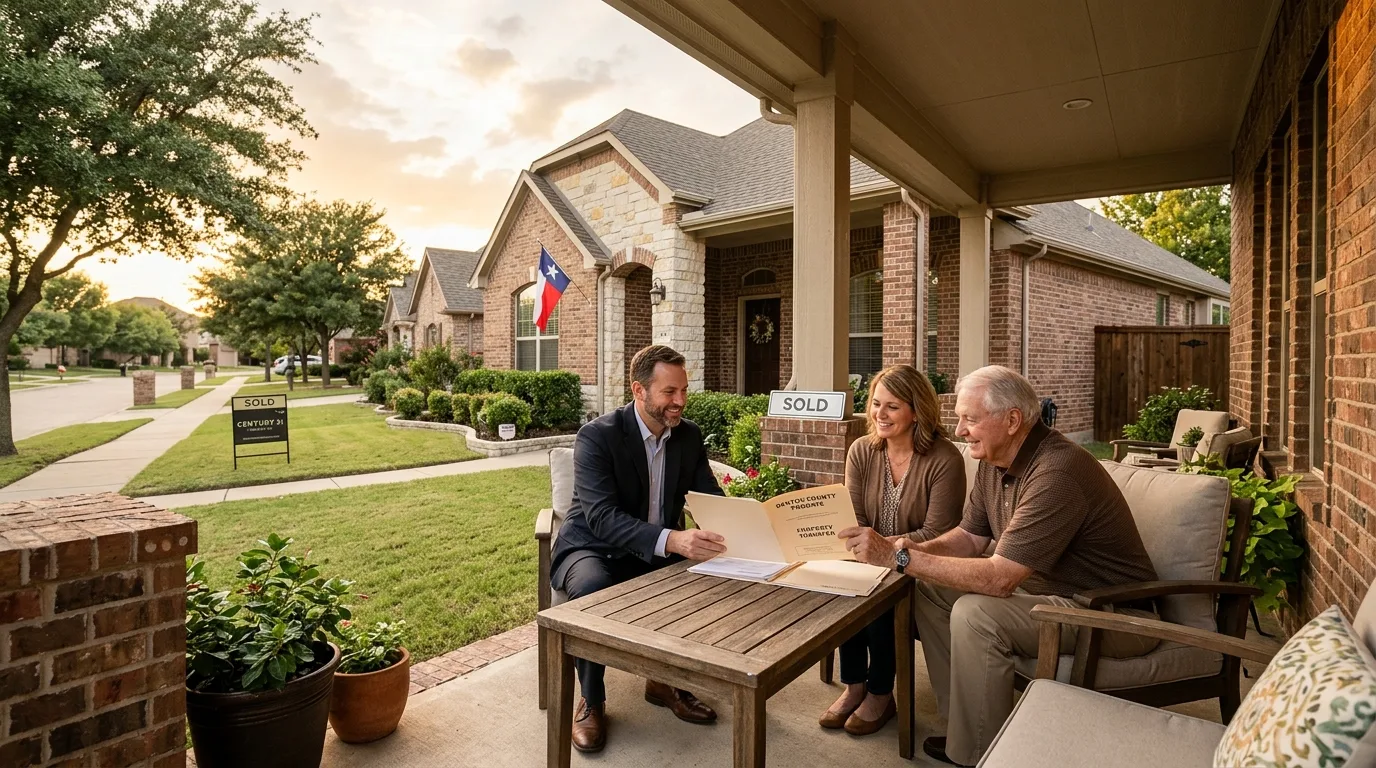
To sell a probate house in Denton, the executor opens probate in the Denton County Probate Court — a dedicated statutory probate court at the Denton County Courts Building — receives Letters Testamentary, and can list the property within 60–90 days. Most Denton probate sales close 4–6 months after Letters issue. There are no upfront fees — a probate real estate consultant works on the same commission as a standard sale, paid only at closing.
Losing a parent whose home is in Denton is hard enough without having to navigate county court procedures at the same time. William Zhang is a probate real estate consultant and the founder of texasprobateprocess.com — he helps Texas executors and heirs navigate the sale of inherited property across all 254 counties, including Denton.
Where Denton Probate Cases Are Filed
Probate in Denton County is filed with the Denton County Probate Court at the Denton County Courts Building (1450 E McKinney St, Denton). Denton is one of the Texas counties with a dedicated statutory probate court — alongside Dallas, Tarrant, Harris, Travis, and Bexar — meaning the probate judge and staff focus on estate and guardianship matters rather than splitting time across other civil dockets.
In practice, that specialization keeps the Denton County Probate Court docket well-managed. Most executors get their first hearing date within three to five weeks of filing.
For a full overview of how probate works in Denton County — timelines, filing locations, and market context — the county guide covers the details. You can also find city-specific context on the Denton city guide.
The Denton Probate Property Sale Process, Step by Step
Selling a probate house in Denton follows the same sequence as any Texas probate sale:
- File the application for probate with the Denton County Probate Court and set a hearing
- Attend the hearing, confirm the will, and qualify as executor
- Receive Letters Testamentary — your legal authority to act on behalf of the estate
- File the estate inventory and appraisement within 90 days
- Publish the creditor notice and wait out the four-month claims period
- List the property (you can do this while the claims period runs)
- Accept an offer, clear title, and close using an executor’s deed
- Pay valid creditor claims, distribute proceeds to beneficiaries, and close the estate
For a thorough walkthrough of every stage — including what title companies need, how to sign the contract as executor, and what happens at closing — see the full Texas probate property sale process guide.
How Long It Takes in Denton County
Here’s a realistic picture for a Denton County independent administration:
- Filing to hearing: 3–5 weeks
- Hearing to Letters Testamentary: Same day or next business day
- Letters to listing-ready: 30–60 days
- List to accepted offer: 30–60 days (faster in higher-demand south Denton)
- Accepted offer to close: 30–45 days
Most executors in an independent administration move from filing to closing in roughly four to six months. Dependent administrations — where the court must approve the sale — run eight to twelve months or more.
Getting a probate attorney involved early keeps your timeline on track. For Texas-wide timeline detail, see How Long Does Probate Take in Texas. For the deadline question, see How Long Does an Executor Have to Sell a House in Texas.
What Denton Probate Houses Are Selling For
Denton’s market reflects its dual identity: a university town with established neighborhoods, and a growing DFW suburb drawing families priced out of Collin County.
Older central Denton — near UNT and Texas Woman’s University — carries a mix of owner-occupants, faculty buyers, and investor interest. Near-campus properties attract an active cash/investor buyer pool you won’t find in most DFW probate markets. Deferred maintenance is more common in this older housing stock.
South and east Denton — master-planned communities like Savannah and Harvest — skews newer and more competitive, driven by DFW spillover demand and retail financed buyers.
What matters for an estate sale is a current comparative market analysis, which a probate real estate specialist provides at no charge before the 90-day inventory deadline.
Common Issues With Denton Probate Properties
Foundation movement. North Texas clay soil expands and contracts with moisture, and older central Denton homes have had decades of this movement. Foundation issues are among the most common deferred maintenance items in Denton probate estates. You don’t need to repair before listing, but you must disclose — the buyer’s inspector will find it.
Multi-heir situations. When multiple heirs inherit together, disagreements about timing or price are common — this is where families get stuck. See Selling Inherited Property With Multiple Heirs in Texas.
Out-of-state heirs. It’s common for an executor or heir to live out of state. The process works remotely; it just requires coordination. The Out-of-State Executor Guide covers what changes.
Tenanted properties. University-adjacent Denton properties are sometimes rented. Selling with existing tenants has specific rules — see Selling an Inherited House With Tenants in Texas.
Selling Before Probate Closes vs. After
You do not have to wait until probate is completely finished to sell. Under an independent administration in Denton County, you can list, accept an offer, and close while probate is still open. You need current Letters Testamentary in hand, and the title company verifies them before insuring the transaction.
What you cannot do is distribute sale proceeds to beneficiaries until the creditor claims period closes and valid claims are paid. The money can sit in the estate account — the sale doesn’t have to wait.
For timing details, see Can You Sell a House Before Probate Closes in Texas?
What It Costs to Sell a Probate House in Denton
Costs fall into two buckets: probate-side and real-estate-side.
Probate-side costs include court filing fees with the Denton County Probate Court (budget a few hundred dollars), attorney fees ($2,000–$4,000 for a straightforward independent administration), and any appraiser fees for the inventory. All of these come from estate funds.
Real-estate-side costs are standard: seller closing costs, title insurance from sale proceeds, and any pre-sale repairs the estate funds. A probate real estate specialist charges no upfront fees — commission is paid at closing.
For the full breakdown, see Cost to Probate a Will in Texas.
Working With a Probate Real Estate Specialist in Denton
What a probate real estate specialist does differently comes down to process knowledge and timing.
A specialist understands what Letters Testamentary are and why the title company needs current ones. They check Denton County deed records for liens before listing, not after an offer surfaces. They provide a comparative market analysis quickly — the 90-day inventory deadline doesn’t wait. They know which Denton submarkets attract investor buyers (near-campus), which attract corporate relocation buyers (south Denton), and which attract local families (established mid-Denton neighborhoods).
They also coordinate with the probate attorney on the court side to keep the real estate and legal timelines aligned. And they don’t charge anything until closing.
The Denton County probate real estate guide is a good starting point for understanding the local court structure before you engage anyone.
Frequently Asked Questions
Can I sell a Denton probate house before probate closes?
Yes. Under an independent administration, you can list, accept an offer, and close while probate is still open. You need current Letters Testamentary and title company confirmation that no court approval is required. Sale proceeds stay in the estate account until the creditor claims period closes and valid claims are paid.
Does Denton County have a probate court?
Yes. Denton County has a dedicated statutory probate court — the Denton County Probate Court — at the Denton County Courts Building, 1450 E McKinney St, Denton. The court hears nothing but estate and guardianship matters, which keeps the docket focused and most independent administration hearings scheduled within three to five weeks of filing.
How long will it take to sell my parent’s Denton house?
For a standard independent administration, most executors close the sale four to six months after opening probate. That covers getting Letters Testamentary (four to six weeks), listing preparation, finding a buyer, and closing. A contested estate or title issue can add time to any stage.
What if I live out of state?
You can manage the Denton sale remotely. Most court steps go through a local probate attorney with minimal in-person appearances. Texas’s remote online notarization statute lets you sign executor’s deeds electronically. The title company coordinates a remote close, and a local probate real estate specialist handles anything requiring a physical presence.
What to Do Next
Selling a probate house in Denton follows a defined sequence — court filing, Letters Testamentary, inventory, creditor notice, listing, close. The steps are manageable with the right support on both the legal and real estate sides.
Texas Probate Process, founded by probate real estate consultant William Zhang, helps families across all 254 Texas counties sell inherited property without the usual confusion. Fill out the form below and we’ll respond within one business day.
Free consultation
Talk to a Denton Probate Real Estate Specialist
Tell us about your Denton probate property. We'll respond within one business day — no obligation.